• Skip to primary navigation
  • Skip to content
  • Skip to primary sidebar

Simplicity Rules

Adam DuVander on keeping it simple

  • About Adam

Lordy, lordy, look who would’ve been forty

February 20, 2007 by Adam DuVander

Today would have been Kurt Cobain’s 40th birthday. For a guy who is etched into our memories at 27, that sounds pretty old (sort of like imagining the forever young JFK, who’d turn 90 this year).

The Belfast Telegraph has a good look at Cobain’s short life and his legacy. In 2002, Pete Townsend reviewed Cobain’s published journals for The Guardian.

I was never much of a fan of Nirvana. A parody of their trademark song did make me a fan of Weird Al, who has a knack for getting the music right. So, through proxy, I came to appreciate the band.

Even more so, I appreciate the impact their music had on the 90s, leading away from the bubble gum 80s, at least for awhile. I have to wonder how Cobain would have continued to influence music and culture if he’d stayed alive. How would he have used the Internet? What would he be writing in his blog on the big Four Oh?

Of course, we can only wonder, so we’re left with the video below, Cobain’s crowning achievement. Sure, it’s Weird Al’s Smell’s Like Nirvana. The legend has it that Cobain realized Nirvana had “made it” when he heard the parody. I don’t want to put words in his mouth, but I think he’d agree this is as good as it gets.


Data rules Amazon

February 19, 2007 by Adam DuVander

Which of these Amazon homepage designs is better?

Amazon homepage A/B test

It turns out it depends what we mean by “better.” My gut would say the one on the right, because the design is cleaner, simpler. Amazon put it to an A/B test and it turns out the one on the left performed better. Orders dropped significantly when Amazon tested the simpler design.

Greg Linden points to a deck of PDF slides by Amazon employees. It’s a couple years old, but has some more good examples of lessons they learned with hard data to back it up.

For a good overview of A/B testing, something most of us can do, check out Jakob Nielsen’s Alertbox.

Ten Simple Ways to Shift Thinking

February 16, 2007 by Adam DuVander

Tara Hunt says community is not the same as a marketing strategy. She shared 10 simple ways to shift thinking.

Tara Hunt at Community Next

  1. Be a community evangelist. Get feedback and learn what you can do better.
  2. Shift your measures of success. PageViews or signups might not be the best yard stick. Find a way to measure true success.
  3. Embrace the chaos. Life isn’t always organized and that’s okay.
  4. Find your higher purpose. Know what you are achieving through the community.
  5. Understand your audience. Who do we serve? Why do they give a damn?
  6. INreach, not outreach. Focus on making your current members happy, not getting more members who will come and go.
  7. Design to delight. Determine the optimal experience and include little things to make people smile.
  8. Be part of the community. Get in there, talk to people, and get to know how they tick.
  9. Marketing is not an afterthought. It’s everything you do. If your product isn’t great, marketing won’t make it so.
  10. Have patience. There are no overnight successes.

(This is part of the CommunityNext Week in Lists. Photo credit: Scott Beale / Laughing Squid)

Ten Monetization Myths

February 15, 2007 by Adam DuVander

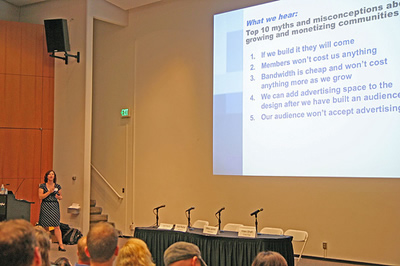
Heather Luttrell knows all about online advertising. She’s the president of Indieclick, an ad network for online communities. She’s talked to many advertisers, publishers, and community members, and she knows how to monetize without upsetting the community.

Heather Luttrell at CommunityNext

Luttrell shared 10 myths and misconceptions about growing and monetizing communities:

  1. If we build it, they will come.
  2. Member acquisition won’t cost us anything.
  3. Bandwidth is cheap and won’t cost any more as we grow.
  4. We can add advertising space to the design after we have built an audience.
  5. Our audience won’t accept ads.
  6. Ads will look terrible.
  7. Direct (or indirect) sales will sell our ads.
  8. We need detailed data to manage sales.
  9. We are getting 1000s of hits. Surely they are worth some ad dollars.
  10. Advertising is our only source of revenue.

(This is part of the CommunityNext Week in Lists. Photo credit: Marc Levin.)

Six Rules of Brand Utopia

February 14, 2007 by Adam DuVander

Josh Spear at CommunityNextJosh Spear and Aaron Dignan believe that a good community has a brand with which its members want to be identified. They call this Brand Utopia and they have six rules.

  1. Know what you care about. It helps to be passionate. This will rub off on your community members.
  2. Do something worth talking about. If nobody cares, then why bother?
  3. Be authentic. Put values before revenue, or your community call you out as a fake… or worse, just leave.
  4. Let the community create you. Continual feedback is key. Integrate with the community, don’t infiltrate.
  5. Operate within the rules of your universe. Your community makes those rules, so gather deep knowledge of your area.
  6. Change the world. Consumer are hungry for purpose.

(This is part of the CommunityNext Week in Lists. Photo credit: Scott Beale / Laughing Squid)

  • « Previous Page
  • Page 1
  • …
  • Page 40
  • Page 41
  • Page 42
  • Page 43
  • Page 44
  • …
  • Page 85
  • Next Page »

Simplicity Series

  • Designing the Obvious
  • Paradox of Choice
  • Laws of Simplicity

Copyright © 2026 · Elevate on Genesis Framework · WordPress · Log in